Across much of Africa, the working day begins on two wheels. Motorcycle taxis, known as boda bodas in East Africa, move people and goods through cities where formal mass transit is thin and roads are congested. The fleet has grown from under five million motorcycles in sub-Saharan Africa in 2010 to an estimated 27 million by 2022, and is projected to approach 55 million by 2030, with around 80 percent used as passenger taxis or for delivery1. In East and Central Africa alone there are an estimated three million registered motorcycle taxis2. For the riders who depend on them, these machines are a livelihood.
That livelihood runs on fuel, and fuel has rarely looked more precarious. As we write in mid-2026, conflict in the Middle East has pushed Brent crude up by more than 55 percent since the war began, with prices spiking toward 120 dollars a barrel as roughly a fifth of the world’s oil trade came under threat3. That pain reaches street level fast: within days of Kenya’s May 2026 pump-price revision, riders were reporting that petrol was taking up nearly half their daily earnings4, against an average fuel spend that FIA Foundation surveys already put at almost 100 dollars a month1. And for riders, global oil shock can be the difference between a profitable day and a wasted one. Electricity, by contrast, is far more stable, especially in a market like Tanzania, where power is cheap, domestically generated and now mostly renewable: hydropower has supplied around two-thirds of the grid since the 2,115 MW Julius Nyerere plant came fully online in 202512.
Electric motorcycles are the obvious answer. The global market for electric two-wheelers was worth around 30 billion dollars in 2022 and is forecast to reach 121 billion by 20305, and McKinsey judges two and three-wheelers to be the most feasible vehicle segment for electrification in sub-Saharan Africa6. But adoption has stalled. Riders must buy a new electric bike outright, the battery alone accounts for 30 to 40 percent of an EV’s cost7, plug-in charging takes hours a working rider cannot spare, and the battery networks that exist are closed and thin on the ground, each tied to a single manufacturer's bike, so none reaches the density that makes swapping convenient. No operator on the continent is yet known to have deployed a genuinely interoperable battery. OKOA was built to break that deadlock.
Transport accounts for more than a third of global CO2 emissions from end-use sectors, according to the International Energy Agency8. In African cities, the millions of small petrol engines running continuous short-distance routes are a concentrated source of both carbon and the street-level air pollution linked to respiratory disease9. OKOA estimates that each electric motorcycle on its network will avoid around two tonnes of CO2 a year7, a gain that compounds with every bike added. But the deepest resilience benefit is economic: electrification cuts a rider’s dependence on imported petrol, a currency-draining lifeline exposed to every distant shock, and replaces it with domestically generated, increasingly renewable power. Cleaner air and healthier lungs follow from that core fix, and so does a steadier income.
Which is why the economics matter as much as the emissions. OKOA’s model is designed to cut a rider’s energy spend by 40 to 60 percent against petrol, lifting take-home income from the first swap7. Riders pay only for the energy they use, at a swap price designed to undercut both petrol and the prevailing rates of East Africa’s established swapping networks7. That benefit widens when global fuel prices spike, as they have through 2026, because a rider on electricity is no longer exposed to the oil market. And because OKOA’s planned smaller stations can reach beyond major city centres and each franchise turns a shop or forecourt into a new income stream, the model spreads inclusion and creates local jobs as it grows, while the payment data it captures begins to build a credit record for riders invisible to formal lenders.
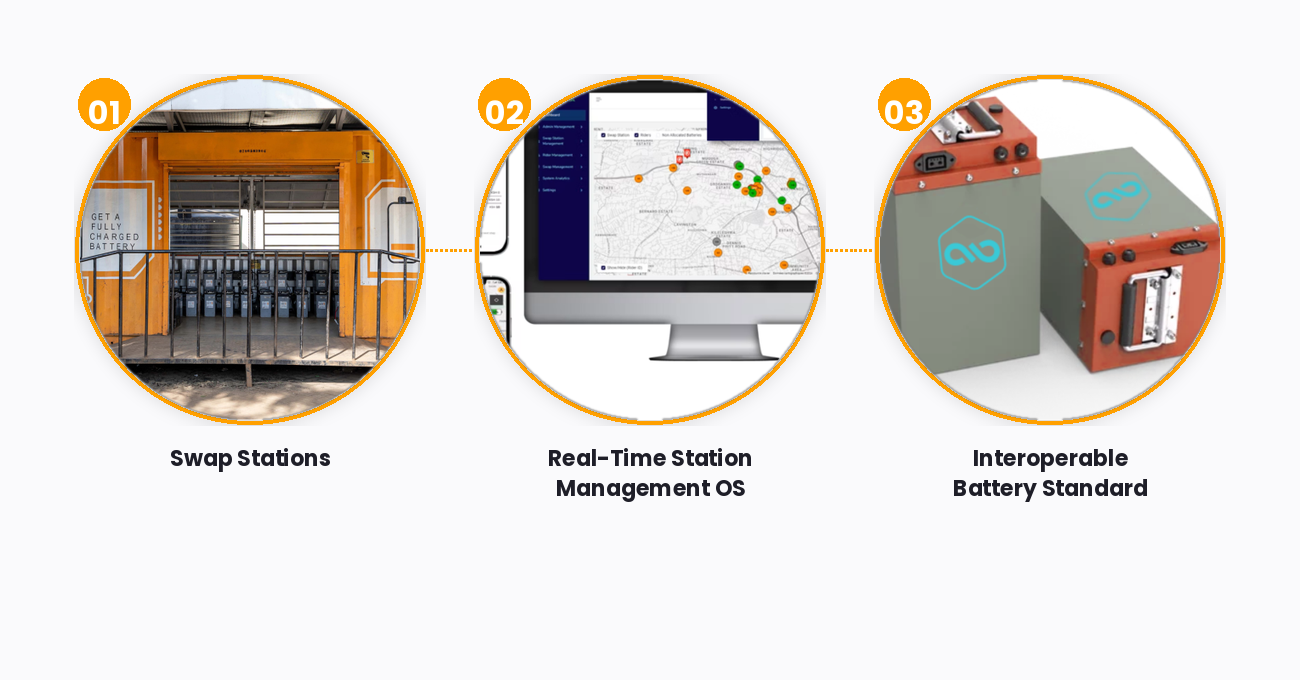
The idea at the centre of OKOA is interoperability. Rather than locking riders into one manufacturer’s bike, OKOA is developing a standardised battery designed to power electric motorcycles from many brands. A swap network is only as useful as it is dense, and a battery that works across many bikes reaches useful density far faster than any single-brand system can. Further, a depleted pack is exchanged for a charged one in about a minute, so a commercial rider loses almost no working time, a decisive advantage over plug-in charging. Then a quiet layer of protection is built into every bike: OKOA's batteries and motorcycles authenticate each other through a protected communication protocol, a digital handshake without which the bike will not run. A battery financed through the network can therefore only earn revenue inside it, which protects the asset and reassures lenders.
The second innovation is financial architecture. Batteries are capital-intensive, and OKOA deliberately separates who owns them from who operates the network. A dedicated battery-asset vehicle owns and finances the packs and makes them available to the operating company at a predictable cost, while the operating company concentrates on deployment, utilisation and rider growth7. This mirrors the structures that built telecom towers and solar-leasing businesses across emerging markets, and it lets OKOA grow without tying up scarce equity in hardware. The timing helps: lithium-ion battery pack prices have fallen by roughly 90 percent over the past decade, from above 1,200 dollars per kilowatt-hour in 2010 to around 108 dollars today10.
Third, OKOA runs the network on an asset-light franchise model and proprietary software. Rather than building stations from scratch, it places swap points inside existing fuel stations, shops and car washes. Each franchise shares the capital cost, can be onboarded in about six weeks, and gains a meaningful new income stream for the host business. Underneath sits the technology the team built at Stima: a hardware-agnostic battery-management platform, STIMA Insight and STIMA Care, that monitors each pack’s health in near real time, optimises charging, predicts maintenance and manages warranty claims as a trusted third party between operator and manufacturer7. Batteries are the single largest cost in the business, so every extra month of life the software extracts from a pack flows straight through to margin.
Few markets are as structurally suited to commercial electric mobility as Africa’s two-wheeler economy, where a fleet heading toward 55 million vehicles1 meets a market forecast to quadruple by 20305. The model is not theoretical: in India, Battery Smart has built a partner-led battery-as-a-service network of around 1,000 stations and tens of millions of swaps, backed by LeapFrog and others11. OKOA is bringing that proven playbook to Africa, anchored on the element that sets it apart: a battery interoperable across manufacturers.
OKOA has chosen its entry point with discipline. It is launching first in Tanzania, where electricity is cheap, the two-wheeler market is large, competition is light and the government is moving toward EV-friendly policy7. Its Cameroon launch has been pulled forward through a partnership with the utility EDF, which has engaged OKOA to supply the batteries, management system and operating technology. Beyond these two markets the company has pre-qualified a pipeline of around 30 cities across six countries7. The asset-light structure makes that trajectory financeable: station costs are shared with franchise partners, battery costs sit in a debt-funded vehicle, and the operating company can expand without a linear increase in either capital or headcount. Revenue recurs with every swap, and each station is designed to deliver infrastructure-grade, project-level returns7, the kind of economics that, once proven, attract the larger pools of infrastructure and debt finance the model is designed to absorb.
Africa’s e-mobility space is growing crowded, which makes the question of who is best placed to win it increasingly important. On OKOA, we have conviction, and it starts with the team. Stima was co-founded in Kenya in 2020 by Jason Gras, Emile Fulcheri and Ahmed Ali, who built an early battery-swapping demonstrator before pivoting to the software that became STIMA Insight and STIMA Care, used by operators across Kenya, Uganda, Ghana and Nigeria7. Alexandre Coster founded OKOA in 2023 and brings the scaling track record: as founding chief executive of Baobab+, he grew the energy-access business across six countries to close to a thousand employees and over 27 million euros in annual revenue, raising more than 45 million euros in debt and equity before a successful exit. The two merged into the OKOA Group in 2024, pairing Stima’s technology with Coster’s execution and fundraising experience.
Their strengths map neatly onto what the business demands: Jason Gras, the deputy chief executive, is a battery engineer fluent in Mandarin who worked across the Chinese supply chain and at the IFC, and anchors OKOA’s manufacturer relationships; Emile Fulcheri, the chief technology officer, is an energy engineer and data scientist trained at Tsinghua and Mines ParisTech who leads the software; and Ahmed Ali, the chief operating officer, helped scale the fintech Sendwave past 500 people and now runs the build-out from Dar es Salaam7. That credibility is visible in everything the company secured while still pre-launch, from manufacturers to franchise hosts to financiers, and each of those relationships deepens OKOA's position as the neutral infrastructure layer beneath many operators rather than a single competing fleet.

We invested in OKOA because it sits at the intersection of climate, livelihoods and infrastructure, and because the incentives across its model align unusually well. Riders save from the first swap and shed their exposure to a fuel market that, in 2026, has rarely looked more volatile. Financiers gain a recoverable, cash-generating asset. Manufacturers and distributors gain an energy and software backbone without having to run a swapping network themselves. The environment benefits as petrol engines are retired from dense urban streets. And because the network is interoperable, every additional bike and every additional station makes the whole system more valuable to everyone on it.
OKOA is at the start of its operational journey, preparing to demonstrate its first interoperable swaps in 2026, and execution risk is real for any company at this stage. But the compounding logic of the model, grounded in how African cities actually move and sharpened by a global fuel shock that makes the switch to electricity more urgent by the month, together with a team that has already done the hard work of assembling the ecosystem, is why we are backing OKOA and why we believe the opportunity ahead of them is substantial.
1. FIA Foundation - The Wheels of Change: Safe and Sustainable Motorcycles in Sub-Saharan Africa (2022)
2. TRT Afrika - 30 years on: Boda-Boda taxis, East Africa’s transport lifeline (2023)
3. CNBC - Oil markets are betting on a swift end to the Iran war (28 May 2026) / Al Jazeera - Oil prices soar on fears of long supply disruption (30 April 2026)
4. The Star (Kenya) - Fuel hike pushes boda boda operators to electric motorbikes (16 May 2026)
5. Grand View Research - Electric Motorcycle Market Size, Share & Trends Report, 2030
7. OKOA - Company data and management projections (2025-2026), reviewed in Catalyst Fund due diligence
8. International Energy Agency - Transport
9. World Health Organization - Ambient (outdoor) air quality and health
10. BloombergNEF - Lithium-Ion Battery Pack Prices Fall to $108 per Kilowatt-Hour (December 2025) / Our World in Data - The price decline of batteries
12. Tanzania electricity mix after the 2,115 MW Julius Nyerere Hydropower Plant (fully commissioned 2025): Africa Energy Portal, Tanzania National Energy Compact; and IEA, Tanzania energy mix
Read more from our team at Catalyst Fund