
Every year the world throws away more than a billion tonnes of food, and that waste does not simply vanish. Food loss and waste already generates between 8 and 10 percent of global greenhouse-gas emissions, and decomposing organic matter in dumpsites and landfills is one of the planet’s largest single sources of methane, responsible for close to a fifth of all human-caused methane emissions.1 That carries outsized urgency, because methane traps roughly 80 times as much heat as carbon dioxide over a 20-year horizon, so the gas rising off a rotting waste heap does disproportionate damage in the near term.2
Africa carries a particularly acute version of this problem. In South Africa alone, about 10 million tonnes of food are wasted every year, and close to 90 percent of it is buried in landfill.3 Across sub-Saharan Africa, an estimated 30 to 50 percent of all food produced is lost after harvest, a destruction of resources worth more than 4 billion dollars a year.4 Much of that loss is woody biomass - palm kernel shells, husks, peels and stalks - that food-processing factories pay to haul away, even as it burns or rots into greenhouse gas.
At the same time, the soil that African agriculture depends on is being exhausted. Roughly three-quarters of the continent’s cultivated land is degraded, stripping 30 to 60 kilogrammes of nutrients from every hectare each year, affecting more than 485 million people, and putting over half of today’s arable land at risk of becoming unusable by 2050.5 Agriculture accounts for around 17 percent of sub-Saharan Africa’s GDP,6 yet climate-driven disasters now cost global agriculture roughly 123 billion dollars a year, and the events behind those losses have quadrupled in frequency since the 1970s.7
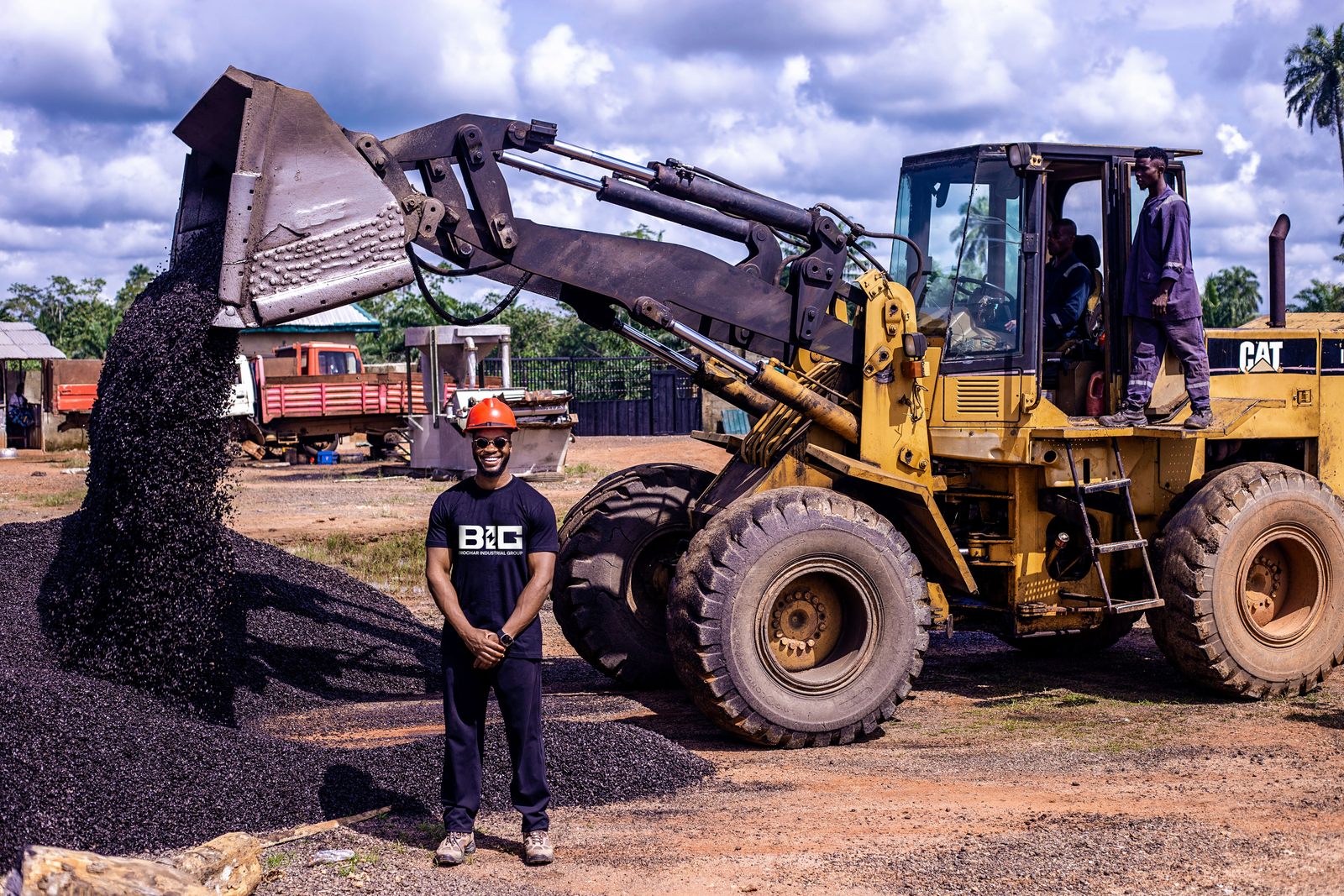
Two crises, and a single missing link between them. The biomass that factories cannot get rid of is precisely the raw material that depleted soils need - provided it can be converted, durably and cheaply, into something farmers will actually use. That conversion is what Biochar Industrial Group (BIG) was built to do. BIG partners with African food-processing factories to turn their low- or negative-value waste into biochar, a stable, carbon-rich material made by heating organic matter in the near-absence of oxygen. The process locks away carbon that would otherwise return to the atmosphere into a form that endures in soil for centuries, generating high-integrity carbon-removal credits, while the biochar itself rebuilds the very farmland the region is losing.
Catalyst Fund backed BIG because it delivers measurable climate and livelihood impact today, deploys a genuinely differentiated low-cost model in an under-served market, and is led by a team that has already spent close to a decade building industrial agriculture in Nigeria.
Biochar occupies a rare position at the intersection of permanent carbon removal and immediate agricultural gain, and BIG is engineered to capture both. Independent assessments put the sustainable climate-mitigation potential of biochar systems at between 2.6 and 10.3 billion tonnes of CO₂-equivalent a year, with the carbon it stores remaining stable in soils on timescales measured in centuries to millennia.8 BIG converts a steady stream of factory residue - at its first site, roughly 250 tonnes a month of palm kernel shells from the Releaf processing facility - into biochar, with each tonne of biomass yielding around 30 percent of its weight in durable char.
The agronomic dividend is just as tangible in a region of acidic, nutrient-poor soils. A meta-analysis drawing on more than a thousand field experiments found that biochar lifts crop yields by about 25 percent in the tropics, while having little effect in temperate soils - precisely because it counteracts the low pH and poor fertility that characterise arable land across much of Africa.9 In BIG’s own controlled trials with the agritech platform ThriveAgric, plots treated with biochar alongside fertiliser outperformed every other combination, and farmers were able to cut fertiliser use by roughly half without sacrificing yield. For smallholders facing rising input costs and degrading land, that is a direct gain in both income and resilience.
The model is also built to keep value local. By co-locating modular pyrolysis units inside factories and operating them with locally hired teams, BIG turns a disposal cost into a shared revenue stream for the factory, creates site-level jobs in operation, logistics and verification, and channels biochar back to the factory’s own farmer networks and through agricultural-input distributors. Waste leaves the system as carbon removal and healthier soil, rather than as methane.
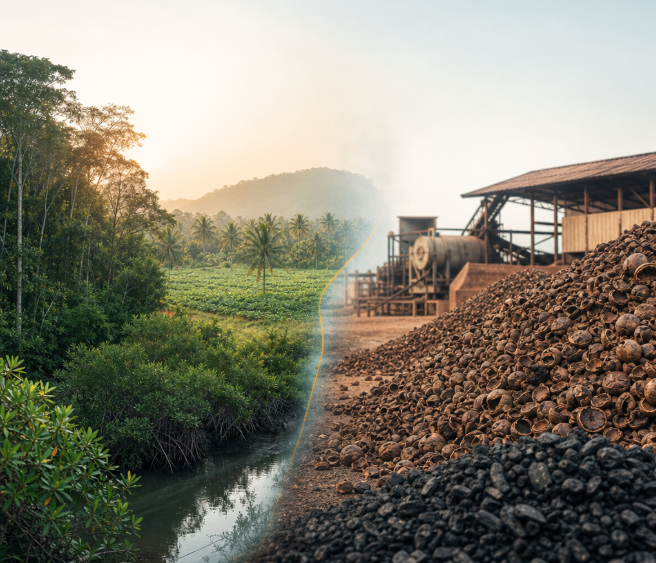
What sets BIG apart is less the chemistry of biochar, which is well understood, than the economics it has engineered around it. Commercial-scale pyrolysis generally needs several thousand tonnes of biomass a year to be viable, and feedstock and logistics are where most projects lose their margin. BIG sidesteps both by going to where the waste already sits: it installs standardised, modular pyrolyzers directly inside partner factories, securing a reliable, low- or negative-cost feedstock and stripping out the transport costs that burden competitors who must gather residues across scattered farms. By adapting commercially available machines to local feedstocks rather than inventing its own, BIG has sharply raised utilisation rates and targets removals at roughly half the cost of typical alternatives.
The second innovation is what happens to the biochar after it is made. Because carbon credits are issued only once the char is durably placed, distribution cannot be left to chance. BIG runs a multi-channel model: biochar flows first to factory-linked farmers and input distributors for agronomic use, and whenever farmer demand is variable, the remainder is routed to engineered deep-soil storage - large covered pits that sequester the carbon permanently at an estimated 18 to 32 dollars a tonne. That fallback protects both unit economics and carbon integrity, neutralising the adoption risk that can derail biochar projects which depend solely on farmer uptake.
Underpinning all of it is measurement. Buyers of carbon removal are scrutinising durability and additionality more closely than ever, and biochar has become the proving ground for that rigour, with dedicated crediting methodologies now established under standards such as Puro.earth, which issued the first biochar methodology in 2019, and Isometric, whose biochar protocol was approved under the Integrity Council’s framework in 2025.13 BIG owns the full monitoring, reporting and verification workflow - geotagged, visual evidence of every batch’s placement - and routes its credits through high-integrity registries and buyers, including the climate-funding platform Milkywire. In a market where trust is the scarce commodity, that traceability is the product.

The demand backdrop could hardly be more favourable. Within the voluntary carbon market, durable removals remain a sliver - only around 4 percent of all credits - even as corporate buyers race to secure them.12 Biochar already dominates what little durable removal is actually delivered: it accounted for 86 percent of all carbon-removal credits delivered and 92 percent of those retired since 2022, and it is the entry point through which most first-time corporate buyers come into the market.10 The reason is economic. Biochar removals are priced well below engineered alternatives, trading in recent years at roughly 125 to 180 dollars a tonne, yet that is many times the roughly 6.50 dollars that the average voluntary carbon credit fetched in 2023 - a premium that reflects genuine permanence.11 The biochar carbon-removal market grew from 14.6 million dollars in 2022 to more than 181 million in 2024,10 and one industry estimate projects the broader biochar carbon-credit market expanding from around 235 million dollars in 2024 to 2.1 billion by 2033.15
Marquee transactions underscore the momentum: in early 2025 Google signed the largest-ever industrial-biochar removal agreement, for 100,000 tonnes, with the Indian developer Varaha - a template BIG aims to bring to West Africa.14 And Africa is unusually well placed to supply this demand, yet unusually under-served. The continent offers abundant low-cost agricultural residues, warm climates that accelerate sequestration, and an overwhelmingly rain-fed farming base that stands to gain most from biochar’s water- and nutrient-retention benefits, while biochar activity itself remains thin, especially in West Africa.
BIG’s commercial model is designed to scale into that gap without consuming equity at every step. While a pyrolyzer is being paid off, carbon revenue is shared between BIG, the factory and the financier under a structured split, and over time BIG intends to fund units through a blend of its own capital, factory co-investment and third-party asset finance - the same logic that allowed distributed-energy and infrastructure businesses to scale across emerging markets. Because the carbon credits are sold in hard currency while much of BIG’s cost base is local, the model carries a natural hedge against the naira volatility that has eroded so many Nigerian businesses.
Conviction in a young company ultimately rests on its people, and BIG’s founders are not newcomers to this problem. Chief executive Ikenna Nzewi, chief technology officer Uzoma Ayogu and chief sustainability officer Isaiah Udotong have built industrial agriculture together for most of a decade through Releaf, the Y Combinator-backed Nigerian agro-processing company they founded in 2017, where they designed patented nut-cracking machinery and sourced feedstock from thousands of smallholder farmers. That history is decisive: BIG’s customers are food factories, and its founders have spent years operating exactly such factories, which gives them both the technical fluency and the relationships to win and serve those clients. The biochar strategy itself was incubated inside Releaf’s own facility, which in 2026 launched what has been reported as Nigeria’s first industrial-scale biochar carbon-removal operation.16

We invested in BIG because it resolves two African crises with a single, self-reinforcing model. Factories shed a costly waste problem and gain a new revenue line; farmers receive a soil amendment that raises yields and cuts input costs; the atmosphere is spared methane today and carbon for centuries; and corporate buyers gain access to exactly the durable, traceable, low-cost removal they are scrambling to secure. Each additional factory makes the network denser and the unit economics stronger, and because the most expensive input - the biomass - is something others pay to discard, BIG begins from a cost advantage few competitors can match.
The company is early, and execution risk is real: pyrolyzers must be deployed, credits issued and verified, and a young market navigated as buyers keep raising the bar on integrity. But the logic is compelling - grounded in how African factories and farms actually operate, sharpened by a global rush toward durable carbon removal, and carried by a team that has already assembled the relationships and the technology the model depends on. That is why we are backing BIG, and why we believe the opportunity ahead of them is substantial.
1. UN Environment Programme - Food Waste Index Report 2024 (2024)
2. IPCC - Sixth Assessment Report, Working Group I: The Physical Science Basis (2021)
3. WWF South Africa - Food Waste initiative (2024)
4. World Bank - Is Post-Harvest Loss Significant in Sub-Saharan Africa? (2022)
5. AUDA-NEPAD - Briefing Note: Addressing Africa’s Soil Health Challenges through the African Fertilizer and Soil Health Action Plan 2024–2034 (2024)
6. World Bank - Agriculture, forestry, and fishing, value added (% of GDP), Sub-Saharan Africa (2024)
7. Food and Agriculture Organization of the United Nations - First-ever global estimation of the impact of disasters on agriculture (2023)
8. Communications Earth & Environment (Nature) - Credible evidence points to gigaton-scale climate change mitigation potential of biochar (2025)
9. Jeffery et al., Environmental Research Letters - Biochar boosts tropical but not temperate crop yields (2017)
10. CDR.fyi - Biochar Carbon Removal Market Snapshot 2025 (2025)
11. Ecosystem Marketplace / Forest Trends - State of the Voluntary Carbon Market 2024 (2024)
12. Carbon Direct - Ten insights for buyers from our 2024 State of the Voluntary Carbon Market report (2024)
13. Puro.earth - Biochar methodology and CO₂ Removal Certificates (2024) / Isometric - Biochar Production and Storage Protocol v1.3 (2025)
14. TechCrunch - Google strikes world’s largest biochar carbon removal deal with Indian startup Varaha (2025)
15. Growth Market Reports - Biochar Carbon Credits Market Research Report 2033 (2024)
16. TechCabal - How Releaf Earth is using biochar to repair soils for Nigerian farmers (2025)
Read more from our team at Catalyst Fund


